Showing posts with label #Teaching Reading Skills. Show all posts

Monday, March 31, 2025

Merging Relevant Topics: Improving the Efficacy of Science of Reading Approaches with Generative Artificial Intelligence (Draft)

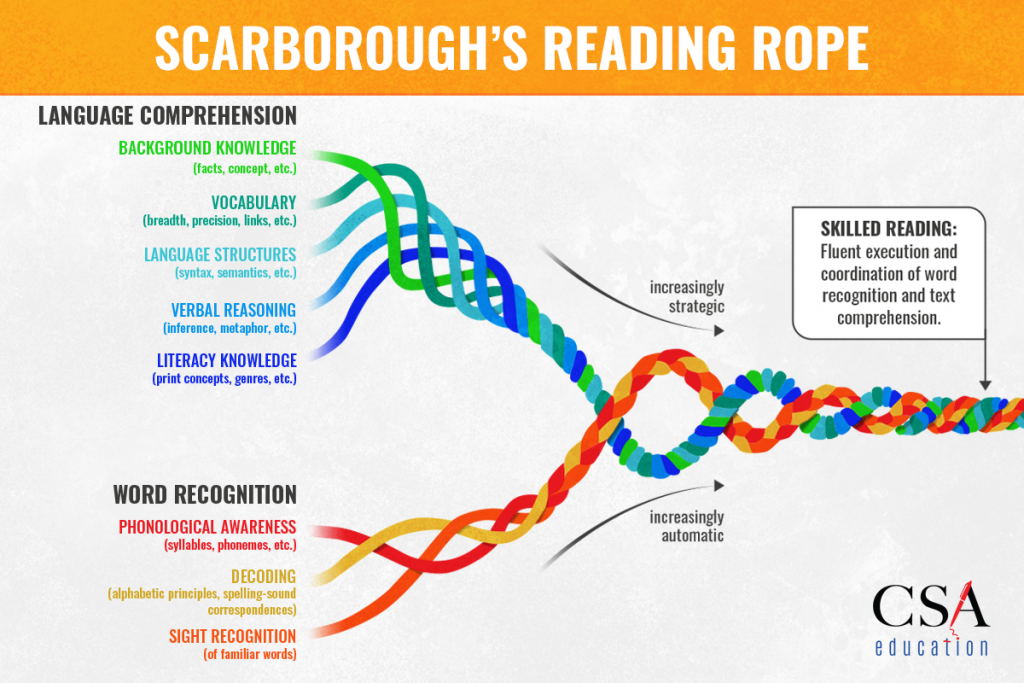
Generative Artificial Intelligence (AI) has significant potential to improve the efficacy of Science of Reading approaches.  Science of Reading is not a single program or product but is constantly evolving based on scientific consensus and peer-reviewed research (Moats, 2020). While embracing the importance of phonemic and phonetic awareness skill development, Science of Reading also incorporates Scarborough’s Reading Rope, which highlights the need for both word recognition skills and language comprehension strategies or proficiencies. This ensures that students don’t just read words but are able to understand and engage with texts.

AI-powered platforms can assess students’ reading abilities in real time and adjust subsequent instruction accordingly. Adaptive learning tools can provide differentiated instruction based on a student’s phonemic awareness, decoding skills, and fluency. AI can track patterns in errors and provide targeted interventions.

The need for effective Teacher Preparation is more crucial than ever. AI can support teacher candidates by simulating real-life classroom scenarios whereby they practice Science of Reading-aligned strategies.  AI-driven coaching tools can provide immediate feedback on lesson delivery, phonics instruction, or error correction.  AI can analyze large datasets to identify which instructional strategies are most effective in different contexts.

Data-driven formative feedback must be valid to provide reliable insights for instruction.  AI can analyze reading assessments and progress monitoring data to identify trends and predict which students may need early intervention.  AI-driven analytics can help schools and teacher preparation programs refine their Science of Reading-based curricula.

AI-Assisted lesson plans and reading interventions can support struggling readers through speech recognition and natural language processing tools that guide pronunciation, fluency, and comprehension. Diagnostically, intelligent tutoring systems can provide scaffolded tiered support to students based on their diverse needs. AI can assist students with reading disabilities by providing customized text-to-speech, visual modifications, or alternative instructional approaches.

Generative AI can help achieve the goal of being effective with students while being efficient with time.  AI can generate instant feedback on student reading fluency, pronunciation, and comprehension. As a result, AI-powered assessment tools can reduce teacher workload while maintaining high-quality, data-driven instruction.

Crucially, Generative AI should be used as a supplement rather than a replacement for an expert teacher.  The professional educator will ensure concerns around data privacy and bias in AI modeling are ethically addressed. Therefore, despite the potential for generalization indicated by previous studies, the effectiveness of Generative AI being aligned with evidence-based Science of Reading practices depends on the quality of training and reliable use of data.  

A comprehensive meta-analysis evaluated the effectiveness of AI interventions in language learning, considering various contextual, instructional, and social-emotional factors (Wu, 2024) and concluded AI interventions significantly improved language learning outcomes, particularly in listening and speaking skills. Medium-duration AI interventions ranging from 6 weeks to 6 months in online and blended learning environments were most effective. Additionally, AI tools positively influenced motivation and reduced language anxiety among learners. Therefore, personalized and adaptive AI tools, especially those providing diverse feedback sources, exhibits the potential to optimize language learning outcomes.

A mixed-methods study of university students examined the effects of AI-mediated language instruction on English learning achievement, motivation, and self-regulated learning among English as a Foreign Language (EFL) learners (Wei, 2023). ​ The experimental group that received AI-mediated instruction demonstrated significantly higher outcomes in grammar, vocabulary, reading comprehension, and writing skills compared to the control group. Furthermore, the experimental group exhibited increased motivation and utilized more self-regulated learning strategies.

AI-driven learning environments were found to effectively promote reading comprehension and foster positive learning behaviors in a study by Shafiee Rad (2025) whereby the impact of AI-based platforms on reading comprehension, engagement, and self-regulated learning among students was investigated. Compared to those students receiving traditional instruction, students using the AI-enhanced platform showed significant improvements in reading comprehension and reported higher levels of engagement and self-regulation.​ To what extent can AI-driven learning environments effectively promote reading comprehension and foster positive learning behaviors will require further research.​

As reported by Hollingsworth (2024) AI-powered assistive technologies are being integrated into educational settings to support students with disabilities, including those with reading challenges such as dyslexia.​ By offering features like speech recognition and word prediction, these AI tools aid students in reading and writing tasks and promoting inclusivity in literacy education. While AI provides valuable support, it's essential to balance its use to ensure it complements traditional learning methods without fostering overreliance.​ Although AI is a game changer for students with disabilities, staff and faculty at educational institutions  are still learning how to utilize and implement it.

These studies and potential applications illustrate the growing role of AI in enhancing reading instruction and aligning with the principles of the Science of Reading. They underscore AI's potential to personalize learning, boost engagement, and support diverse learner needs. However, they also highlight the importance of thoughtful implementation and ongoing evaluation to address challenges and maximize benefits.

Several AI-powered tools align with the Science of Reading principles, focusing on phonemic awareness, phonics, fluency, vocabulary, and comprehension. These tools provide personalized learning, adaptive instruction, and real-time feedback to enhance literacy instruction. Based on categorically emphasis, let’s discuss established programs and those gaining traction to better understand how Generative AI can improve the efficacy of Science of Reading approaches.

Amplify Reading and Lexia Core5 Reading provide AI tools for phonemic awareness and phonics. Amplify Reading uses AI to personalize phonics instruction and scaffold phonemic awareness through adaptive learning paths, real-time student data, and Science of Reading -aligned decodable texts. Its programming is most suitable for K-5 students, particularly struggling readers. Lexia Core5 Reading provides structured literacy instruction, targeting phonemic awareness, phonics, and fluency through AI-driven progress monitoring, explicit instruction, and scaffolded support. Its programming addresses the needs of Pre-K-5 students needing systematic phonics instruction.

ReadWorks and Curipod provide AI tools for fluency and reading comprehension.  ReadWorks uses AI to enhance comprehension through text scaffolding and question generation. The program provides differentiated reading assignments, AI-powered text simplification, and comprehension quizzes. It is recommended for students in Grades 1-12, particularly for improving comprehension skills. Curipod AI generates interactive Science of Reading-aligned lesson plans and assessments. Its AI-driven lesson creation, real-time comprehension checks, and engagement analytics can help teachers seeking to design structured reading lessons.

SoapBox Labs and Read AI by Microsoft provide tools for AI-powered reading intervention.  SoapBox Labs uses AI for speech recognition in literacy, through voice AI to analyze reading fluency and pronunciation errors. Its AI-driven speech-to-text analysis, real-time feedback, and Science of Reading-aligned reading fluency support early readers and struggling readers needing pronunciation support. Read AI by Microsoft tracks reading progress, provides real-time feedback, and assesses fluency. Its AI-generated reading reports, automatic error detection, and personalized interventions are a resource for teachers needing automated fluency assessments.

Quillionz and ChatGPT provide AI tools for vocabulary and language development.  Quillionz uses AI to generate comprehension questions and quizzes based on Science of Reading-aligned texts. Its AI-powered question generation, vocabulary reinforcement, and interactive activities supports teachers seeking to design vocabulary and comprehension assessments. ChatGPT can be adjusted to generate decodable texts, phonics exercises, and reading interventions based on Science of Reading principles. The result is the potential for AI-driven lesson planning, real-time student engagement tools, and scaffolded learning activities that support educators seeking to create custom Science of Reading-aligned content.

Regardless of the instructional intervention, it is crucial to recognize efficacy does not entail teaching alone.  A highly qualified teacher understands the ongoing relationship between the curriculum, his or her instruction, and ongoing assessment of learning.  So, again, AI should supplement and never replace structured Science of Reading instruction.  The effective educator will regularly and reliably assess student progress and adapt the utilization of AI accordingly.  Lastly, we all must be mindful and vigilant of student data security in AI-powered platforms.


To cite:

Anderson, C.J. (March 31, 2025) Merging relevant topics: Improving the efficacy of science of reading approaches with generative artificial intelligence. [Web log post] Retrieved from http://www.ucan-cja.blogspot.com/


References:


 Kim, Y.-S., Wagner, R. K., & Lopez, D. (2012). Developmental relations between reading fluency and reading comprehension: A longitudinal study from grade 1 to grade 2. Journal of Experimental Child Psychology , 113(1), 93-111. doi: 10.1016/j.jecp.2012.03.002 

Moats, L. C. (2020). Speech to print: Language essentials for teachers (3rd ed.).Brookes Publishing. 

Shafiee Rad, H. (2025). Reinforcing L2 reading comprehension through artificial intelligence intervention: refining engagement to foster self-regulated learning. Smart Learning. Environments. 12, 23. https://doi.org/10.1186/s40561-025-00377-2


Wei L. (2023) Artificial intelligence in language instruction: impact on English learning achievement, L2 motivation, and self-regulated learning. Front Psychology. 14:1261955. doi: 10.3389/fpsyg.2023.1261955. PMID: 38023040; PMCID: PMC10658009.

Wu, X.Y (2024) Artificial intelligence in L2 learning: A meta-analysis of contextual, instructional, and social-emotional moderators. System, Volume 126, 103498, ISSN 0346-251X, https://doi.org/10.1016/j.system.2024.103498


Wednesday, February 26, 2025

Not Just Good Branding: How Science of Reading Can be a More Effective Process for Teaching Diverse Learners to Read

Regardless of the instructional intervention, it is crucial to recognize efficacy does not entail teaching alone.  A highly qualified teacher will understand the ongoing relationship between the curriculum, his or her instruction, and ongoing assessment of learning.  Competency regarding this relationship should be exhibited through increased classroom assessment literacy whereby standards-based instruction is continually provided and monitored through diverse and consistent formative and criterion assessments.

Undoubtedly, programs that utilize a phonemic and phonological awareness approach in a multisensory, systemic reading intervention model offer research-based Tier 3 RTI.  However, for at least two years following successful participation in any early intervention program, the effective school needs to ensure the student is exposed to “good classroom instruction and moderate personal motivation that should be achievable” (Clay, 2005, p. 52).  Providing instructional leaders with the skills to advance these competencies and promoting professional development in the area of classroom assessment literacy will address the need to optimize learning and sustain success.  Such an endeavor exhibits the vision for excellence in education and promotes the mission of learning for all. 

The Science of Reading is more than just a buzzword; it is grounded in a vast body of interdisciplinary research from cognitive science, neuroscience, linguistics, and education. Its effectiveness in teaching diverse learners to read—especially those who struggle with traditional methods—comes from its evidence-based, structured, and explicit approach to reading instruction. Documented improved literacy outcomes is what makes Science of Reading more than just good branding.

In contrast to spoken language, reading is not a naturally occurring skill that the brain automatically picks up. Science of Reading leverages research on how the brain processes print.  The Five Pillars of early literacy identified by the National Reading Panel (2000), suggests successful reading instruction must include systematic and explicit teaching of foundational skills such as phonemic awareness, phonics, fluency, vocabulary, and comprehension.

Regardless if identified as dyslexic, are English Language Learners (ELLs), or from varying socio-economic backgrounds, diverse learners benefit from explicit phonics instruction. To address this need, Science of Reading emphasizes:

  • Teaching phonemes (speech sounds) explicitly so students can decode words efficiently.
  • Connecting phonics instruction to spelling and writing.
  • Ensuring students develop automaticity in recognizing words so they can focus on comprehension.

Science of Reading approaches have been particularly beneficial for students with dyslexia and reading difficulties. Yet, it supports all learners by providing a structured, cumulative approach to literacy. Unlike a balanced literacy approach that encourages using pictures cues or context clues, Science of Reading ensures that all students learn to systematically decode. Phonemic and phonetic awareness skills are explicitly and directly taught. This foundational emphasis contradicts three-cueing approaches whereby students are encouraged to guess words using context clues or pictures cues rather than using decoding skills. Research shows that struggling readers, in particular, do not benefit from this strategy and the inferential approach can widen literacy gaps over time.

While embracing the importance of phonemic and phonetic awareness skill development, Science of Reading also incorporates Scarborough’s Reading Rope, which highlights the need for both word recognition: decoding and language comprehension: background knowledge, vocabulary, syntax. This ensures that students don’t just read words (word call) but are able to understand and engage with texts.  The latter is especially important for multilingual learners and students from diverse linguistic backgrounds. Therefore, Science of Reading is not a single program or product but is constantly evolving based on scientific consensus and peer-reviewed research. The conceptual framework for Science of Reading is supported by decades of studies on reading acquisition and intervention.

Some critics argue that Science of Reading has become a branding tool.  With publishers and training programs using the term loosely, this will always be a concern for this or any program.  However, when implemented with fidelity rather than cursory-level training or reliance upon overview materials, Science of Reading has been shown to significantly improve literacy outcomes for all students. How can the efficacy of Science of Reading professional development be optimized?

Implementing the Science of Reading through teacher preparation programs will require a shift from traditional literacy instruction to evidence-based practices that align with reading science. To promote this transformational change, teacher preparation programs should implement the following strategies:

  • Ensuring coursework covers how the brain learns to read:
    • Reading courses need to emphasize phonemic awareness, phonics, fluency, vocabulary, and comprehension.
  • Introducing teacher candidates to Scarborough’s Reading Rope and The Simple View of Reading
    • Provide opportunities for the model to show how word recognition and language comprehension work together.
  • Addressing problems with previous reading instruction systems,
    • Identify ineffective practices for diverse learners such as three-cueing and leveled reading approaches that do not embrace explicit phonics instruction.
  • Teaching their candidates systematic instruction and explicit phonics techniques.
  • Modeling and practicing diagnostic assessments
    • Such as phonemic awareness screening and decoding assessments
      • Ensures future teachers can identify and address reading difficulties early.
  • Training teacher candidates in multisensory approaches
    • Orton-Gillingham based methods for engaging diverse learners.
  • Incorporating clinical field experiences whereby candidates practice structured literacy with real students.
    • Including ELLs and students with dyslexia.
  • Partnering with schools implementing Science of Reading-aligned curricula to provide placements that would provide authentic exposure.
  • Teaching how to use reading assessments
  • Integrating decodable texts that reinforce phonics skills with leveled readers for subsequent language comprehension skill development.
    • Teaching candidates how to balance knowledge-building with phonics instruction using content-rich texts across disciplines.
  • Ensuring Science of Reading practices are adapted for linguistically and culturally diverse learners
    • Integrating oral language development, background knowledge building, and morphological instruction
      • Crucial for ELLs.
  • Incorporating high-quality texts that reflect diverse experiences while maintaining a focus on structured literacy.
  • Equipping teacher candidates with research and tools to advocate for evidence-based literacy instruction in their future classrooms and districts.

The Science of Reading is being widely adopted because it has been proven effective.  It is rooted in research on how the brain learns to read.  Science of Reading provides structured, explicit, and systematic instruction that benefits all learners, especially those who struggle. While the term, “Science of Reading” may be marketed, its core principles, especially when correctly applied, typically lead to more equitable and effective literacy instruction across diverse student populations.

 To cite:

Anderson, C.J. (February 27. 2025) Not just good branding: How Science of Reading can be a more effective process for teaching diverse learners to read. [Web log post] Retrieved from http://www.ucan-cja.blogspot.com/


References;


Big Ideas in Beginning Reading (2009) University of Oregon Center on Teaching and Learning

Retrieved from:  http://reading.uoregon.edu/resources/bibr_pa_concepts.pdf  

Brown, R. (2021). Understanding dyslexia. A whitepaper published by for Illuminate Education

Burkins, J., & Yates, K. (2021). Shifting the balance: 6 ways to bring the science of reading

into the balanced literacy classroom. Stenhouse Publishers.


Chall, J.S. (1983) Stages of reading development. McGraw Hill.


Clay, M. M. (1993). Reading recovery. Heinemann


Coley, J.D. & Hoffman, D.M (1990). Overcoming learned helplessness in at-risk readers. Journal of Reading v33. n7 497-508.


Ehri, L.. Dreyer, L., Flugman,B. and Gross, A. Alan. (2007) Reading Rescue: An effective

tutoring intervention model for first-grade struggling readers. American Educational

Research Journal, 44,414-448.  

Ehri, L. C., Nunes, S. R., Willows, D. M., Schuster, B. V., Yaghoub-Zadeh, Z., & Shanahan, T. (2001) Phonemic awareness instruction helps children learn to read: Evidence from the national reading panel's meta-analysis. Reading Research Quarterly 36 (3). 250-287 http://dx.doi.org/10.1598/rrq.36.3.2  

Hennessy, N. (2021). The reading comprehension blueprint: Helping students make meaning from text. Brookes Publishing. 

International Dyslexia Association. (2008). Just the Facts: Multisensory Structured Language Teaching. Reading Research Quarterly, 36(3), 250-287. doi: 10.1598/RRQ.36.3.2


Kame'enui, E. J., Simmons, D. C., Baker, S., Chard, D. J., Dickson, S. V., Gunn, B.,

Smith, S. B.,Sprick, M., & Lin, S. J. (1997). Effective strategies for teaching

beginning reading. In E. J Kame'enui, & D. W. Carnine (Eds.), Effective Teaching

Strategies That Accommodate Diverse Learners Merrill. 

Kilpatrick, D. A. (2016). Equipped for reading success: A comprehensive, step-by-step program for developing phonemic awareness and fluent word recognition. Casey & Kirsch Publishers.  

Kim, Y.-S., Wagner, R. K., & Lopez, D. (2012). Developmental relations between reading fluency and reading comprehension: A longitudinal study from grade 1 to grade 2. Journal of Experimental Child Psychology , 113(1), 93-111. doi: 10.1016/j.jecp.2012.03.002


Lyons, C.A. (1989) Reading recovery: A preventative for labeling young at-risk learners. Urban Education v 24, n2 125-39.  

Melby-LervÃ¥g, M., Lyster, S.-A. H., & Hulme, C. (2012). Phonological skills and their role in learning to read: A meta-analytic review. Psychological Bulletin, 138(2), 322-352. doi: 10.1037/a0026744 

Moats, L. C. (2020). Speech to print: Language essentials for teachers (3rd ed.). Brookes Publishing. 

Moats, L. C., & Tolman, C. A. (2019). LETRS: Language essentials for teachers of reading and spelling. Voyager Sopris Learning. 

National Early Literacy Panel. (2008). Developing Early Literacy: A Scientific Synthesis of Early Literacy Development and Implications for Intervention. National Institute for Literacy. 


National Reading Panel (2000). Teaching children to read: An evidence-based assessment of

the scientific research literature on reading and its implications for reading instruction

[online]. Retrieved from: http://www.nichd.nih.gov/publications/nrp/smallbook.htm. 

Rosenthal, J., & Ehri, L. C. (2008). The mnemonic value of orthography for vocabulary learning. Journal of Educational Psychology, 100(1), 175-191. 

Slavin, R. E., Lake, C., Davis, S., & Madden, N. A. (2011). Effective programs for struggling                readers: A best-evidence synthesis. Educational Research Review, 6(1), 1–26.                doi:10.1016/j.edurev.2010.07.002


Vacca, R. T. & Padak, N. D. (1990). Who's at risk in reading? Journal of Reading v33. n7

486-88.