Wednesday, February 26, 2025

Not Just Good Branding: How Science of Reading Can be a More Effective Process for Teaching Diverse Learners to Read

Regardless of the instructional intervention, it is crucial to recognize efficacy does not entail teaching alone.  A highly qualified teacher will understand the ongoing relationship between the curriculum, his or her instruction, and ongoing assessment of learning.  Competency regarding this relationship should be exhibited through increased classroom assessment literacy whereby standards-based instruction is continually provided and monitored through diverse and consistent formative and criterion assessments.

Undoubtedly, programs that utilize a phonemic and phonological awareness approach in a multisensory, systemic reading intervention model offer research-based Tier 3 RTI.  However, for at least two years following successful participation in any early intervention program, the effective school needs to ensure the student is exposed to “good classroom instruction and moderate personal motivation that should be achievable” (Clay, 2005, p. 52).  Providing instructional leaders with the skills to advance these competencies and promoting professional development in the area of classroom assessment literacy will address the need to optimize learning and sustain success.  Such an endeavor exhibits the vision for excellence in education and promotes the mission of learning for all. 

The Science of Reading is more than just a buzzword; it is grounded in a vast body of interdisciplinary research from cognitive science, neuroscience, linguistics, and education. Its effectiveness in teaching diverse learners to read—especially those who struggle with traditional methods—comes from its evidence-based, structured, and explicit approach to reading instruction. Documented improved literacy outcomes is what makes Science of Reading more than just good branding.

In contrast to spoken language, reading is not a naturally occurring skill that the brain automatically picks up. Science of Reading leverages research on how the brain processes print.  The Five Pillars of early literacy identified by the National Reading Panel (2000), suggests successful reading instruction must include systematic and explicit teaching of foundational skills such as phonemic awareness, phonics, fluency, vocabulary, and comprehension.

Regardless if identified as dyslexic, are English Language Learners (ELLs), or from varying socio-economic backgrounds, diverse learners benefit from explicit phonics instruction. To address this need, Science of Reading emphasizes:

  • Teaching phonemes (speech sounds) explicitly so students can decode words efficiently.
  • Connecting phonics instruction to spelling and writing.
  • Ensuring students develop automaticity in recognizing words so they can focus on comprehension.

Science of Reading approaches have been particularly beneficial for students with dyslexia and reading difficulties. Yet, it supports all learners by providing a structured, cumulative approach to literacy. Unlike a balanced literacy approach that encourages using pictures cues or context clues, Science of Reading ensures that all students learn to systematically decode. Phonemic and phonetic awareness skills are explicitly and directly taught. This foundational emphasis contradicts three-cueing approaches whereby students are encouraged to guess words using context clues or pictures cues rather than using decoding skills. Research shows that struggling readers, in particular, do not benefit from this strategy and the inferential approach can widen literacy gaps over time.

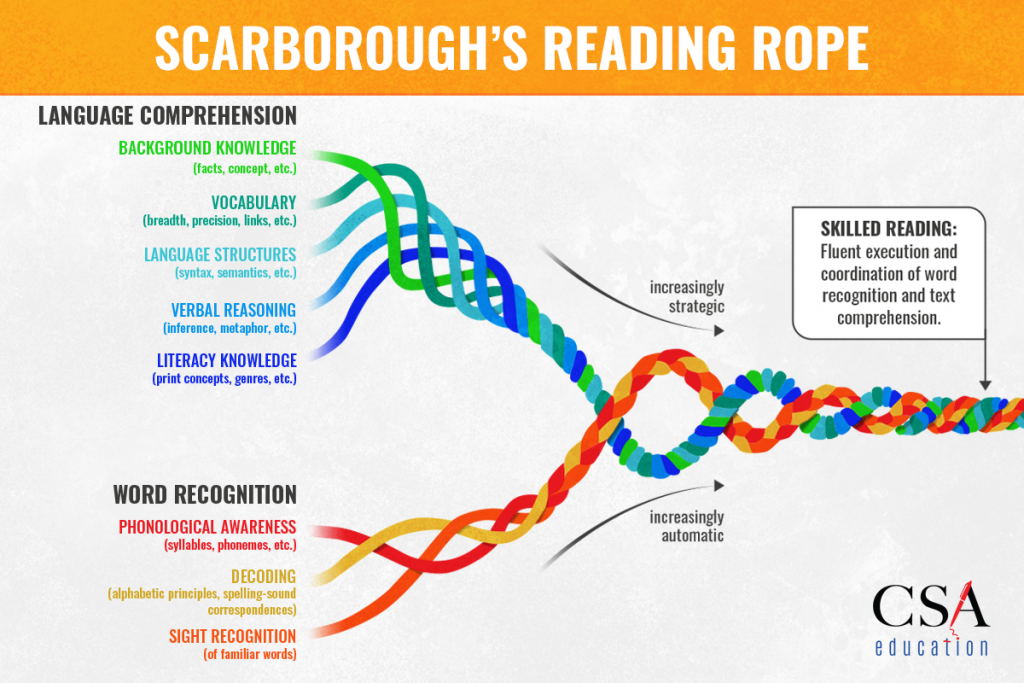
While embracing the importance of phonemic and phonetic awareness skill development, Science of Reading also incorporates Scarborough’s Reading Rope, which highlights the need for both word recognition: decoding and language comprehension: background knowledge, vocabulary, syntax. This ensures that students don’t just read words (word call) but are able to understand and engage with texts.  The latter is especially important for multilingual learners and students from diverse linguistic backgrounds. Therefore, Science of Reading is not a single program or product but is constantly evolving based on scientific consensus and peer-reviewed research. The conceptual framework for Science of Reading is supported by decades of studies on reading acquisition and intervention.

Some critics argue that Science of Reading has become a branding tool.  With publishers and training programs using the term loosely, this will always be a concern for this or any program.  However, when implemented with fidelity rather than cursory-level training or reliance upon overview materials, Science of Reading has been shown to significantly improve literacy outcomes for all students. How can the efficacy of Science of Reading professional development be optimized?

Implementing the Science of Reading through teacher preparation programs will require a shift from traditional literacy instruction to evidence-based practices that align with reading science. To promote this transformational change, teacher preparation programs should implement the following strategies:

  • Ensuring coursework covers how the brain learns to read:
    • Reading courses need to emphasize phonemic awareness, phonics, fluency, vocabulary, and comprehension.
  • Introducing teacher candidates to Scarborough’s Reading Rope and The Simple View of Reading
    • Provide opportunities for the model to show how word recognition and language comprehension work together.
  • Addressing problems with previous reading instruction systems,
    • Identify ineffective practices for diverse learners such as three-cueing and leveled reading approaches that do not embrace explicit phonics instruction.
  • Teaching their candidates systematic instruction and explicit phonics techniques.
  • Modeling and practicing diagnostic assessments
    • Such as phonemic awareness screening and decoding assessments
      • Ensures future teachers can identify and address reading difficulties early.
  • Training teacher candidates in multisensory approaches
    • Orton-Gillingham based methods for engaging diverse learners.
  • Incorporating clinical field experiences whereby candidates practice structured literacy with real students.
    • Including ELLs and students with dyslexia.
  • Partnering with schools implementing Science of Reading-aligned curricula to provide placements that would provide authentic exposure.
  • Teaching how to use reading assessments
  • Integrating decodable texts that reinforce phonics skills with leveled readers for subsequent language comprehension skill development.
    • Teaching candidates how to balance knowledge-building with phonics instruction using content-rich texts across disciplines.
  • Ensuring Science of Reading practices are adapted for linguistically and culturally diverse learners
    • Integrating oral language development, background knowledge building, and morphological instruction
      • Crucial for ELLs.
  • Incorporating high-quality texts that reflect diverse experiences while maintaining a focus on structured literacy.
  • Equipping teacher candidates with research and tools to advocate for evidence-based literacy instruction in their future classrooms and districts.

The Science of Reading is being widely adopted because it has been proven effective.  It is rooted in research on how the brain learns to read.  Science of Reading provides structured, explicit, and systematic instruction that benefits all learners, especially those who struggle. While the term, “Science of Reading” may be marketed, its core principles, especially when correctly applied, typically lead to more equitable and effective literacy instruction across diverse student populations.

 To cite:

Anderson, C.J. (February 27. 2025) Not just good branding: How Science of Reading can be a more effective process for teaching diverse learners to read. [Web log post] Retrieved from http://www.ucan-cja.blogspot.com/


References;


Big Ideas in Beginning Reading (2009) University of Oregon Center on Teaching and Learning

Retrieved from:  http://reading.uoregon.edu/resources/bibr_pa_concepts.pdf  

Brown, R. (2021). Understanding dyslexia. A whitepaper published by for Illuminate Education

Burkins, J., & Yates, K. (2021). Shifting the balance: 6 ways to bring the science of reading

into the balanced literacy classroom. Stenhouse Publishers.


Chall, J.S. (1983) Stages of reading development. McGraw Hill.


Clay, M. M. (1993). Reading recovery. Heinemann


Coley, J.D. & Hoffman, D.M (1990). Overcoming learned helplessness in at-risk readers. Journal of Reading v33. n7 497-508.


Ehri, L.. Dreyer, L., Flugman,B. and Gross, A. Alan. (2007) Reading Rescue: An effective

tutoring intervention model for first-grade struggling readers. American Educational

Research Journal, 44,414-448.  

Ehri, L. C., Nunes, S. R., Willows, D. M., Schuster, B. V., Yaghoub-Zadeh, Z., & Shanahan, T. (2001) Phonemic awareness instruction helps children learn to read: Evidence from the national reading panel's meta-analysis. Reading Research Quarterly 36 (3). 250-287 http://dx.doi.org/10.1598/rrq.36.3.2  

Hennessy, N. (2021). The reading comprehension blueprint: Helping students make meaning from text. Brookes Publishing. 

International Dyslexia Association. (2008). Just the Facts: Multisensory Structured Language Teaching. Reading Research Quarterly, 36(3), 250-287. doi: 10.1598/RRQ.36.3.2


Kame'enui, E. J., Simmons, D. C., Baker, S., Chard, D. J., Dickson, S. V., Gunn, B.,

Smith, S. B.,Sprick, M., & Lin, S. J. (1997). Effective strategies for teaching

beginning reading. In E. J Kame'enui, & D. W. Carnine (Eds.), Effective Teaching

Strategies That Accommodate Diverse Learners Merrill. 

Kilpatrick, D. A. (2016). Equipped for reading success: A comprehensive, step-by-step program for developing phonemic awareness and fluent word recognition. Casey & Kirsch Publishers.  

Kim, Y.-S., Wagner, R. K., & Lopez, D. (2012). Developmental relations between reading fluency and reading comprehension: A longitudinal study from grade 1 to grade 2. Journal of Experimental Child Psychology , 113(1), 93-111. doi: 10.1016/j.jecp.2012.03.002


Lyons, C.A. (1989) Reading recovery: A preventative for labeling young at-risk learners. Urban Education v 24, n2 125-39.  

Melby-LervĂ„g, M., Lyster, S.-A. H., & Hulme, C. (2012). Phonological skills and their role in learning to read: A meta-analytic review. Psychological Bulletin, 138(2), 322-352. doi: 10.1037/a0026744 

Moats, L. C. (2020). Speech to print: Language essentials for teachers (3rd ed.). Brookes Publishing. 

Moats, L. C., & Tolman, C. A. (2019). LETRS: Language essentials for teachers of reading and spelling. Voyager Sopris Learning. 

National Early Literacy Panel. (2008). Developing Early Literacy: A Scientific Synthesis of Early Literacy Development and Implications for Intervention. National Institute for Literacy. 


National Reading Panel (2000). Teaching children to read: An evidence-based assessment of

the scientific research literature on reading and its implications for reading instruction

[online]. Retrieved from: http://www.nichd.nih.gov/publications/nrp/smallbook.htm. 

Rosenthal, J., & Ehri, L. C. (2008). The mnemonic value of orthography for vocabulary learning. Journal of Educational Psychology, 100(1), 175-191. 

Slavin, R. E., Lake, C., Davis, S., & Madden, N. A. (2011). Effective programs for struggling                readers: A best-evidence synthesis. Educational Research Review, 6(1), 1–26.                doi:10.1016/j.edurev.2010.07.002


Vacca, R. T. & Padak, N. D. (1990). Who's at risk in reading? Journal of Reading v33. n7

486-88.


Friday, January 31, 2025

Embracing AI to Create Effective Reading Groups Providing Multi-Tiered Systems of Support


Recall that last May 2024, we noted that a Professional Learning Community (PLC) invites learning by doing and that this process is optimized through intentional, caring, optimistic, respectful, and trustworthy (ICORT) mindsets (Purkey & Novak, 2016; Anderson, 2021), which fosters a positive and supportive learning environment.  It was suggested that a school having a PLC focusing on generative artificial intelligence (AI) policy development and best-practice curriculum integration can identify where additional support or training was needed.

This month let’s model the work of a PLC using Open AI to concretely exhibit how to optimize differentiated Multi-Tiered Systems of Support (MTSS) into instructional groups that address diverse learning needs. Yes, elementary teachers can use generative artificial intelligence to plan implementation of differentiation to effectively address the diverse reading needs of their learners (OpenAI, personal communication, January 31, 2025). Minimally, AI can help the Elementary teacher by:

           Assessing and Monitoring Student Progress

           Creating Personalized Reading Interventions

           Helping to Differentiate Instructional Planning

           Automating Administrative Tasks

           Supporting Teacher Collaboration and Professional Development

How can generative artificial intelligence help assess and monitor student progress? AI can analyze student reading levels through online assessments, oral reading fluency tools, or comprehension checks to determine which MTSS tier is appropriate. Then AI can continuously monitor student growth and flag those needing interventions. Adaptive learning platforms such as Lexia or i-Ready can provide real-time feedback to teachers.

Can generative artificial intelligence help create personalized reading interventions? AI-driven reading platforms adjust difficulty based on individual student responses, providing tailored instruction for Tier 1 (core instruction), Tier 2 (targeted intervention), and Tier 3 (intensive intervention). So, yes. Tools like ChatGPT can generate individualized reading exercises, comprehension questions, and phonics activities based on student data.

How can generative artificial intelligence help teachers differentiate instructional planning? AI can suggest differentiated lesson plans based on student data, incorporating scaffolding strategies, leveled texts, and multisensory activities. Ideally, this will be further shown below. Crucially, AI tools like ChatGPT can rewrite passages at different reading levels, ensuring accessibility for all learners.

How might AI help teachers by automating administrative tasks? Well, AI can suggest fluid grouping based on ongoing assessment data, ensuring students receive appropriate interventions. This helps with data-driven decision making through generated reports for teachers, highlighting trends in student progress and recommending instructional strategies.

Lastly, let’s consider how AI can support and further enhance teacher collaboration and professional development. Teachers can use AI to find research-based strategies, lesson ideas, and evidence-based interventions aligned with MTSS, RTI, or whatever your school calls its tiered intervention approach. AI-powered coaching tools can recommend instructional strategies and provide just-in-time learning opportunities for teachers.

In this regard, let’s now review a sample of AI-powered interventions for groups of elementary students that are often placed in a single, fourth grade public school classroom. Most elementary teachers should recognize the following sample of reading profiles.  In today’s inclusive environments it is usual to find students reading up to two-levels below grade, students that are English language learners, and students at grade level that struggle with effectively implementing essential literacy strategies. 

Early Grade 4, Sample Group: Tier 3 Profile:

Reading Challenges: Difficulty decoding multisyllabic words, struggles with sight word recognition, slow reading fluency. 2nd grade reading level.

Assessment Data:

           Oral Reading Fluency: 35 WPM (below benchmark of 50 WPM)

           Phonics Screener: Difficulty blending long vowel sounds and consonant blends

           Comprehension: Struggles with understanding when reading independently

AI-Powered Intervention Plan

1. Targeted Phonics Instruction (15 min daily – Small Group or 1:1)

           AI Tools:

Lexia Core5 or Reading Horizons: Adaptive phonics lessons personalized to Students’ specific skill gaps.

ChatGPT-based phonics practice: AI generates custom decodable word lists based on phonics patterns students struggles with (e.g., “silent e” words: hope, tape, bike).

           Activities:

AI-generated phonics word sorts (real vs. nonsense words).

Voice-assisted blending exercises where AI pronounces words, and students decipher them.

2. Fluency Development (15 min – Paired & Independent Practice)

           AI Tools:

ReadTheory or Raz-Kids: AI-adaptive passages at her level, tracking her WPM progress.

Speech-to-Text AI (e.g., FluencyTutor by Texthelp): Analyzes students’ oral reading for accuracy, rate, and expression.

           Activities:

AI-generated repeated reading passages: Students read a passage multiple times, AI tracks improvement.

Echo Reading with AI tutor: AI reads aloud, Students repeat for modeling fluency.

3. Sight Word Recognition (10 min – Gamified Practice)

           AI Tools:

Quizlet AI-powered flashcards with voice recognition for automatic correction.

AI-generated sentences using high-frequency words in meaningful contexts.

           Activities:

AI reads sight words aloud; Students type what she hears.

AI gamifies sight word recognition (e.g., matching words to pictures).

4. Comprehension & Vocabulary (15 min – Digital & Hands-on Activities)

           AI Tools:

ChatGPT-generated leveled texts: Adjusts reading passages to her comprehension level.

Kid-friendly AI chatbots (e.g., BookBot) to ask interactive comprehension questions.

           Activities:

AI provides oral comprehension questions with scaffolding.

AI suggests graphic organizers for students to map story elements.

5. Progress Monitoring & Adjustments

           AI Tools:

AI Dashboard (e.g., i-Ready, Star Reading) to track fluency, phonics progress, and comprehension growth.

ChatGPT-generated weekly reports summarizing areas of progress and next steps.

           Teacher Actions:

Review AI data weekly for adjustments in intervention intensity.

Shift focus areas based on real-time performance.

Outcome Goals (6-8 Weeks):

         Increase fluency to 50+ WPM.

         Master 10+ new sight words per week.

         Improve phonics decoding of vowel teams and silent "e" words.

         Demonstrate improved comprehension with 80% accuracy in response to reading.

(OpenAI, personal communication, January 31, 2025)

Early Grade 4, Sample Group: Tier 2 Vocabulary & Fluency Intervention for ELL Students

Challenges:

           Limited academic vocabulary knowledge

           Struggles with English pronunciation and fluency

           Needs support understanding idioms and figurative language

Assessment Data:

           WIDA ACCESS Score: 3.5 (Developing level in reading & speaking)

           Fluency: Reads 50 WPM, below the 3rd-grade benchmark of 80 WPM

AI-Powered Intervention Plan

1. Vocabulary Acquisition (15 min – Interactive Practice)

AI Tools:

           ChatGPT-generated vocabulary games: AI creates custom fill-in-the-blank exercises using targeted words.

           Visual dictionary tools (like Rewordify or LingQ): AI converts texts into simpler forms with image support.

Activities:

           AI-generated sentence completion tasks: Student fills in missing words in context.

           Real-world application: AI suggests real-life conversation starters using new words.


2. Fluency Development (15 min – Repeated Reading & AI Feedback)

AI Tools:

           Speech-to-Text AI (like Fluency Tutor or Google Read Aloud): AI evaluates students’ reading pace, pronunciation, and expression.

           AI-read-aloud apps (like NaturalReader): Provides native-speaker modeling.

Activities:

           Choral reading with AI: AI reads first, Student echoes for fluency practice.

           AI-generated text chunking: AI breaks sentences into meaningful parts to improve pacing.


3. Comprehension & Conversation (20 min – Discussion & Response)

AI Tools:

           BookBot or ChatGPT conversational prompts: AI asks inferential and open-ended questions.

           AI-generated comic strips: Helps Student visualize and discuss language concepts.

Activities:

           AI-simulated conversation: AI provides dialogue practice with automatic corrections.

           Story retelling with AI feedback: Students retell a story, and AI prompts for richer language use.


4. Progress Monitoring & Adjustments

AI Tools:

           AI-generated weekly pronunciation feedback using speech recognition tools.

           AI progress tracker (like WIDA Can-Do Descriptors) to evaluate fluency growth.

Teacher Actions:

           Adjust vocabulary difficulty based on AI insights.

           Increase speaking tasks as fluency improves.

Outcome Goals (6-8 Weeks):

         Increase oral reading fluency to 80+ WPM.

         Expand Tier 2 vocabulary knowledge by 15+ words per week.

         Use complete sentences and basic idioms in conversations.

(OpenAI, personal communication, January 31, 2025)


Early Grade 4, Sample Group: Tier 2 Reading Comprehension Intervention

Reading Challenges:

           Struggles with identifying main ideas and details

           Difficulty making inferences from texts

           Reads fluently but lacks comprehension

Assessment Data:

           Reading Lexile: 650L (below grade level expectation of 770L)

           Low scores on inference-based and summarization questions

AI-Powered Intervention Plan

1. Explicit Comprehension Strategy Instruction (20 min – Small Group or 1:1)

AI Tools:

           ChatGPT-generated scaffolding prompts: AI provides sentence starters for summarizing or inferencing.

           ReadTheory or Newsela: AI-adaptive reading passages with comprehension quizzes at Students’ level.

Activities:

           AI-generated "Think Aloud" modeling: AI reads passages aloud, pausing to verbalize thought processes.

           Summarization scaffolding: AI provides chunked text with guiding questions like “What was the problem?”

2. Vocabulary Development for Deep Understanding (15 min – Interactive Activities)

AI Tools:

            Quizlet AI-powered flashcards: Generates vocabulary sets with images, definitions, and example sentences.

           ChatGPT synonym expansion: AI suggests words with different levels of complexity to deepen understanding.

Activities:

           AI-generated context clues exercises: Students guess word meanings based on AI-provided example sentences.

           Semantic mapping: AI generates word association maps for deep learning.

3. Guided Close Reading Practice (20 min – Text Annotation & Discussion)

AI Tools:

           CommonLit or Actively Learn: AI-annotated passages with guiding questions.

           ChatGPT-generated comprehension questions: Adjusts based on Students’ responses.

Activities:

           AI suggests text annotation prompts (“Highlight evidence supporting the character’s emotions”).

           AI-driven Socratic discussions: AI chatbot engages students in text-based discussions.

4. Progress Monitoring & Adjustments

AI Tools:

           AI Dashboard (i-Ready, Star Reading) to track comprehension growth.

           ChatGPT-generated weekly reports with skill breakdowns and next steps.

Teacher Actions:

           Review AI insights on students’ inference and main idea performance.

           Adjust text complexity every 2 weeks based on growth.

Outcome Goals (6-8 Weeks):

         Accurately answer 80% of inference and main idea questions.

         Improve reading Lexile by at least 75L.

         Write clear, concise summaries of grade-level texts.

(OpenAI, personal communication, January 31, 2025)

Ideally, it has been helpful to discuss the benefits of an AI-focused Professional Learning Community at your school to be a place for collaborative teaching and learning. Unquestionably, it also needs to provide regular evaluation and feedback.  Monitoring and evaluating research projects will ensure compliance with ethical standards. The PLC can establish channels for educators to provide anonymous feedback on ethical concerns within the community.

By reviewing and reflecting upon the sample AI-Powered Intervention Plans above, perhaps you feel more enthusiastic or empowered to participate in your school’s AI-focused PLC. An effective educational leader promotes transparency and professional development. The goal should be to always create a culture of ethical research practice among educators and learners. You are professionally invited to ensure that generative artificial intelligence is used responsibly and effectively.

To Cite:

Anderson, C.J. (May 31, 2024). Embracing AI to create effective reading groups providing multi-tiered systems of support [Web log post] Retrieved from http://www.ucan-cja.blogspot.com/

References:

Anderson, C. J. (2021). Developing your students' emotional intelligence and philosophical perspective begins with I-CORT. Journal of Invitational Theory and Practice, 27, 36-50. 

Atlas, S. (2023) ‘ChatGPT for higher education and professional development: A guide to conversational AI’, College of Business Faculty Publications [Preprint]. Available at: https://digitalcommons.uri.edu/cba_facpubs/548


DuFour, R., DuFour, R., & Eaker, R. (2008). Revisiting professional learning communities at work: New insights for improving schools. Bloomington, IN: Solution Tree Press.


Dufour, R. (2006). Learning by doing: A handbook for professional learning communities at work. Bloomington, IN: Solution Tree Press.

Purkey, W. W., & Novak, J. M. (2015). Fundamentals of invitational education. (2nd Ed) International Alliance for Invitational Education. Retrieved from: Fundamental of Invitational Education | IAIE

U.S. Department of Education, Office of Educational Technology (2023), Artificial Intelligence and Future of Teaching and Learning: Insights and Recommendations. Retrieved from: Artificial Intelligence and the Future of Teaching and Learning (ed.gov)

Monday, December 30, 2024

An Educator’s I-CORT Mindset and Unconditional Positive Regard Strengthens Any Lesson’s Relevance

Previously we discussed how the alignment of persuasive strategies with instructional goals can allow educators to deepen the perceived relevance of intended learning outcomes.  By creating a sense of value, promoting collaboration, and encouraging participation, the effective educator provides students with meaningful resources, constructive feedback, or personalized support. In educational settings, perceived authority optimizes the learning milieu because the educator is seen as capable of leading, so students become more willing to follow. Yet, beyond exhibiting content knowledge, the teacher’s role is to strengthen the learners’ industry as they progress through what Vygotsky called the zone of proximal development (1978).  Does it not make sense that relevance withers whenever a student lacks self-efficacy, industry, and resiliency?

In Erikson’s stage of industry vs. inferiority, which typically is undertaken during ages 6–12, students seek to develop competence and master tasks valued by society. Of course, this includes academic and practical skills. Success at this psychosocial stage fosters a sense of industry, while repeated failure can lead to feelings of inferiority. Being provided opportunities to engage in meaningful, productive work help students develop confidence in their abilities. This is because as students succeed in tasks and receive recognition for their efforts, their self-efficacy grows, thereby reinforcing their self-efficacy and resiliency related to undertaking future challenges. When teachers provide consistent, encouraging feedback they help students overcome feelings of inferiority, bolstering self-efficacy and resiliency.  This is why the educators will benefit by being intentionally inviting (Purkey, Novak, & Fretz, 2020), exhibiting unconditional positive regard (Rogers, 1959), and promoting a growth mindset (Dweck, 2014).  

Recall that educators exhibiting an intentional, caring, optimistic, respectful, and trusting (ICORT) mindset (Purkey & Novak, 2015; Anderson, 2024) can influence the students' perceived relevance by inviting two elements of the Principle of Persuasion. Yes, the students perceiving the educator as credible and knowledgeable, may inspire the students’ sense of obligation to engage and optimally contribute. However, an educator’s failure to understand every student’s perceived relevance of the lesson at hand and his or her zone of proximal development is typically related to the student’s current level of self-efficacy, industry, and resiliency as related to the need to exhibit any skill or knowledge.

Therefore, let us consider the correlations between a teacher’s exhibition of Carl Rogers’ unconditional positive regard, a student’s self-efficacy, and the application of Lev Vygotsky’s zone of proximal development (ZPD). This analysis will reflect upon how these elements can interact to foster a supportive and growth-oriented learning environment. Unconditional Positive Regard (Rogers, 1957) refers to the teacher's acceptance, empathy, and respect for the student as they are, without judgment or conditions. Why is this important?

Whenever students feel valued and supported unconditionally, they are more likely to develop confidence in their abilities. The teacher's belief in the student's potential helps the student internalize a sense of competence, fostering self-efficacy. Therefore, the emotional safety provided by the teacher’s exhibited unconditional positive regard encourages risk-taking in learning, which is an essential factor in building self-efficacy, industry and resiliency.

Vygotsky’s ZPD describes the space where a learner can achieve tasks with the guidance of a more knowledgeable other. This typically is the teacher but should not be seen as an exclusive relationship.  When the more knowledgeable other exhibits unconditional positive regard towards the learner, the ensuing trustful relationship encourages the learner to engage fully in challenging tasks within their ZPD. Therefore, by exhibiting unconditional positive regard, the teacher or any more knowledgeable other minimizes the learner’s fear of failure, enabling students to persist in tasks that are slightly beyond their current abilities but achievable with support. This is the very epitome of building self-efficacy, industry and resiliency.

Creating a learning environment that builds each learner’s high self-efficacy enhances willingness to tackle tasks within one’ ZPD.  As students successfully complete tasks within their ZPD with appropriate scaffolding, their confidence grows. This increased self-efficacy makes them more willing to take on challenges. When students feel capable, they are more likely to assert their industry in learning decisions and problem-solving.

Given trust has been established in the instructional environment, perceived relevance is increased because success is seen as possible given intentional guidance and the student’s willing effort. A student's belief in her or his ability influences the willingness to engage in the scaffolding process as provided by the I-CORT minded teacher who will consistently exhibit unconditional positive regard.  Therefore, as students succeed in tasks within their ZPD, their willingness is reinforced, creating a cycle of confidence and capability that fuels their self-efficacy, industry and resiliency.

When a teacher combines unconditional positive regard with effective scaffolding practices that are aligned with the learner’s ZPD, the I-CORT minded educator has created an effective learning environment that empowers the learners’ self-efficacy, industry and resiliency.  Providing emotional and instructional support to undertake and master complex tasks encourages students to trust their developing abilities. When students feel accepted and supported unconditionally, they become more willing to engage in challenging learning experiences that fall within their ZPD, thereby accelerating their growth and increasing their perception of any lesson’s relevance.


To Cite:

Anderson, C.J. (December 30, 2024). An educator’s I-CORT mindset and unconditional positive regard strengthens any lesson’s relevance. [Web log post] Retrieved from http://www.ucan-cja.blogspot.com/


References:

Anderson, C. J. (2021). Developing your students' emotional intelligence and philosophical perspective begins with I-CORT. Journal of Invitational Theory and Practice, 27, 36-50.

Dweck, C. S. (2008). Mindsets and math/science achievement. Carnegie Corporation of New York-Institute for Advanced Study Commission on Mathematics and Science Education. Retrieved from https://www.carnegiescience.edu

Dweck, C. S. (2014, November). The power of believing that you can improve [Video]. TED Conferences. https://www.ted.com

Purkey, W. W., & Novak, J. M. (2015). Fundamentals of invitational education. (2nd Ed) International Alliance for Invitational Education. Retrieved from: Fundamental of Invitational Education | IAIE

Purkey, W.W., Novak, J.M., & Fretz, J.R. (2020). Developing inviting schools: A beneficial framework for teaching. Teachers College Press.

Rogers, C. R. (1957). The necessary and sufficient conditions of therapeutic personality change. Journal of Consulting Psychology, 21(2), 95–103. https://doi.org/10.1037/h0045357

Vygotsky, L. S. (1978). Mind in society: The development of higher psychological processes. Harvard University Press.


Saturday, November 30, 2024

Establishing Perceived Authority, Reciprocity, and the Principle of Persuasion to Optimize Relevance

 As rooted in social and behavioral psychology, the Principle of Persuasion can be a powerful pedagogical tool applied to learning, particularly when seeking to establish relevance. By aligning persuasive strategies with instructional goals, educators can deepen the perceived relevance of the material, which can inspire students to engage meaningfully with the content.  Reciprocity describes the natural human tendency to feel obligated to return a favor or respond in kind to positive actions received from others.

The desire for reciprocity is foundational to building relationships, fostering cooperation, and creating a sense of mutual respect (Brehm & Witte, 2022). Reciprocity is not transactional but rather relational, thereby building trust and goodwill over time. This desire operates across cultures, making it a versatile universal tool in human interaction. The feeling of obligation to give back is often emotionally rooted in gratitude or social norms. In educational contexts, reciprocity can be used to foster engagement and inspiration.

By creating a sense of value, promoting collaboration, and encouraging participation, the effective educator provides students with meaningful resources, constructive feedback, or personalized support. This can encourage students to reciprocate by engaging more actively in class or assignments. For instance, students in group work who help one another are likely to receive support in return, creating a positive cycle of cooperation. When an instructor shares personal anecdotes or real-life applications, students may feel encouraged to share their own experiences, thereby enriching class discussions.

The reciprocity norm builds relevance through mutual exchange. People are more likely to engage when they feel they’re receiving something of value in return. So, the effective educator needs to provide something of value first. The educator offering time, effort, or expertise establishes goodwill and thereby subconsciously encourages students to reciprocate through increased effort, participation, or engagement.

Offering resources, tools, or support early in the course creates goodwill and fosters engagement. Sharing the direct, relevant benefits of the content initiates the desire to reciprocate.  For instance, "Learning these provided skills will help you excel in real-world problem-solving or your future career as a…[fill in the blank]", is specific, direct, and relevant.  Planning for reciprocity creates opportunities for students to share their experiences, which empowers and makes them feel valued.

For reciprocity to be effective in a learning or instructional context, authority must first be established.  Authority enhances the credibility and perceived value of what is being offered (McCroskey & Teven, 2016). Learners are more likely to view the educator’s feedback, resources, or support as valuable when the educator is perceived as a knowledgeable, competent authority. Without authority, learners may question whether the “favor” or effort provided is meaningful or worth reciprocating.

People are more likely to feel obligated to reciprocate when the giver is someone they respect or trust.  Authority lends weight to the interaction, making students feel that reciprocation through participation or completion of tasks is not just expected but worthwhile. Therefore, a student is more likely to put effort into an assignment when they believe the educator’s feedback comes from a position of expertise and can genuinely improve their learning.

In educational settings, perceived authority establishes a natural structure whereby the educator leads and the students follow. Reciprocity operates effectively within this structure because students view the educator’s contributions as both intentional and deserving of effort in return. As a positive consequence, when an educator shares valuable study techniques and demonstrates their effectiveness, students are more inclined to apply these methods and share their own success stories. By contrast, whenever authority isn’t perceived or established, the relationship may feel peer-like, and students might undervalue what is being offered to them.

Authority reinforces that the educator is uniquely positioned to provide resources, insights, or guidance that cannot be easily obtained elsewhere (Weeks, ArdĂšvol-Abreu & de ZĂșñiga, 2017).  Learners are less likely to resist reciprocating when they recognize the educator’s authority and the legitimacy of the effort being asked in return. In this vein, authority minimizes skepticism or doubt about the educator’s intentions or the relevance of the course material.

An intentional, caring, optimistic, respectful, trusting (ICORT) mindset (Purkey & Novak, 2015; Anderson, 2021) can be more inviting for implementing two elements of the Principle of Persuasion that can optimize students' perceived relevance.   Authority creates the foundation of trust and respect that makes the desire for reciprocity more powerful. When students perceive the educator as credible and knowledgeable, they are more likely to value the educator's efforts and feel a sense of obligation to engage and optimally contribute.


To Cite:

Anderson, C.J. (November 30, 2024) Establishing perceived authority, reciprocity, and the principle of persuasion to optimize relevance. [Web log post] Retrieved from http://www.ucan-cja.blogspot.com/


References:

Anderson, C. J. (2021). Developing your students' emotional intelligence and philosophical perspective begins with I-CORT. Journal of Invitational Theory and Practice, 27, 36-50.

Brehm, S., & Witte, K. (2022). Engaging persuasion: What should undergraduate students enrolled in a persuasion course learn? Journal of Educational Communication Research, 48(3), 112-128. Retrieved from ERIC

McCroskey, J. C., & Teven, J. J. (2016). The impact of instructor credibility on student learning. Communication Education, 55(3), 223-237. https://doi.org/10.1080/03634520600750532

Purkey, W. W., & Novak, J. M. (2015). Fundamentals of invitational education. (2nd Ed) International Alliance for Invitational Education. Retrieved from: Fundamental of Invitational Education | IAIE

Weeks, B., ArdĂšvol-Abreu, A., & de ZĂșñiga, H. G. (2017). Online persuasion: Instructor credibility and the post-truth era. Computers in Education, 65(1), 45-62. https://doi.org/10.1016/j.compedu.2016.12.006